


11
Jun
How Does a 3D Printer Work? A Complete Beginner’s Guide to 3D Printing
3D printing has transformed the way products are designed, prototyped, and manufactured. What once required expensive machinery and complex production lines can now be achieved using a desktop 3D printer.
Whether you’re a student, engineer, architect, hobbyist, or business owner, understanding how does a 3D printer works is the first step toward unlocking the full potential of additive manufacturing technology.
In this guide, you’ll learn exactly how 3D printing works, how a digital design becomes a physical object, the different types of 3D printing technologies and the materials used in modern 3D printers.
What Is 3D Printing?
3D printing is a manufacturing process that creates physical objects layer by layer from a digital 3D model.
Unlike traditional manufacturing methods that remove material through cutting, drilling, or machining, 3D printing adds material precisely where it is needed.
Because of this approach, 3D printing is commonly known as additive manufacturing.
The technology allows users to produce:
- Functional prototypes
- Engineering components
- Architectural models
- Medical devices
- Consumer products
- Educational projects
- Customized parts
Today, industries worldwide rely on 3D printing for faster product development, reduced manufacturing costs, and greater design flexibility.
How Does a 3D Printer Work? Step-by-Step Process
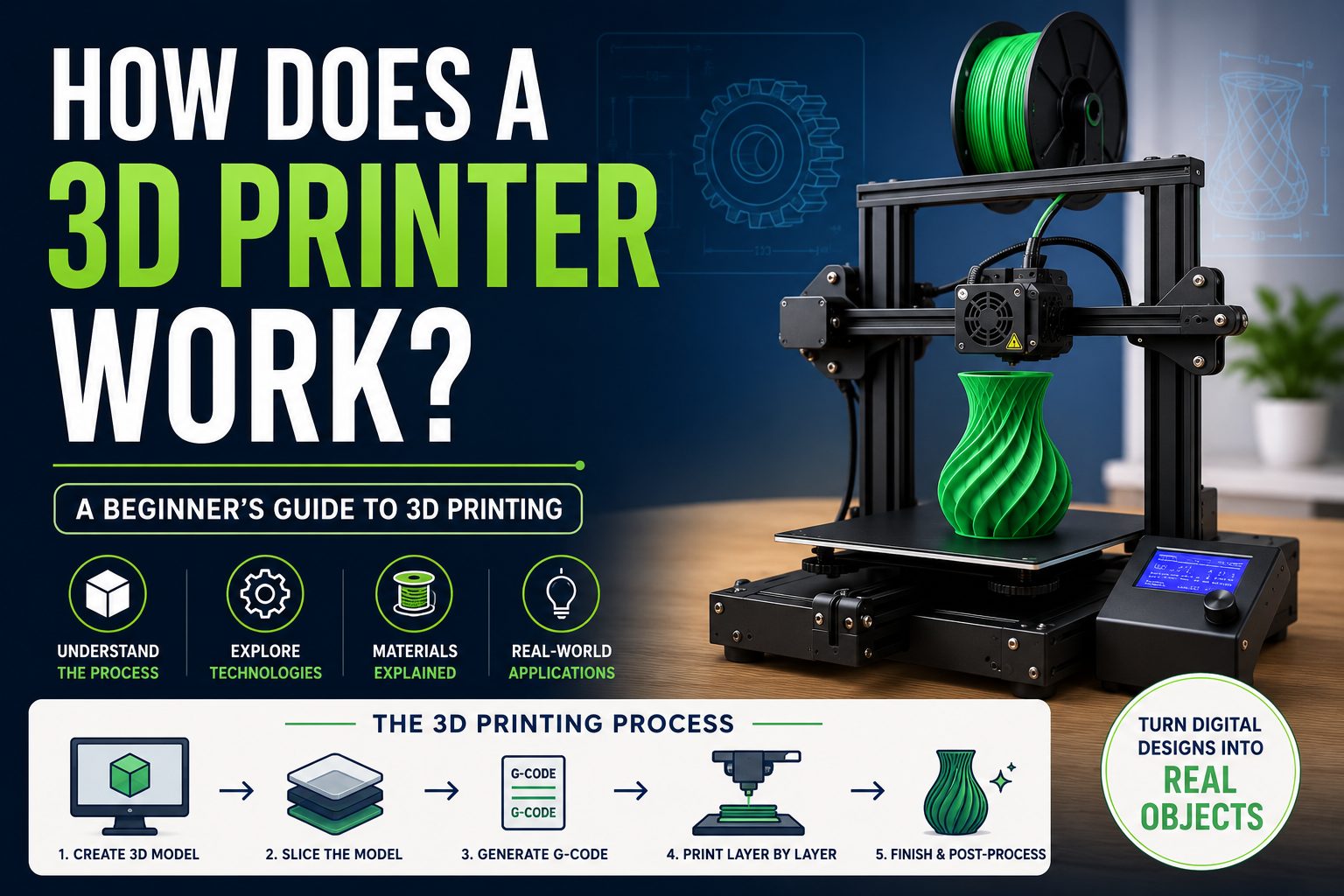
To understand how 3D printing works, imagine building a structure one thin layer at a time until the final object is complete.
The process follows several key stages.
Step 1: Creating a 3D Model
Every 3D printed object starts with a digital design.
The model is created using CAD (Computer-Aided Design) software such as:
- Fusion 360
- SolidWorks
- Tinkercad
- Blender
- SketchUp
The designer creates a virtual representation of the object, including dimensions, geometry, and structural details.
Once completed, the file is exported into a format that the printer can understand, typically:
- STL
- OBJ
- 3MF
This digital file serves as the blueprint for the entire printing process.
Step 2: Slicing the Model
A 3D printer cannot directly interpret a CAD file.
The model must first be processed through slicing software.
Popular slicers include:
- Cura
- Creality Print
- PrusaSlicer
- Simplify3D
The slicing software divides the object into hundreds or even thousands of horizontal layers.
During this stage, the software also determines:
- Layer height
- Print speed
- Infill density
- Support structures
- Print temperature
The final output is called a G-code file.
This file contains detailed instructions that tell the printer exactly how to build the object.
Step 3: Preparing the 3D Printer
Before printing begins, the machine must be prepared correctly.
This includes:
- Loading filament or resin
- Leveling the build platform
- Setting print temperatures
- Checking nozzle condition
- Ensuring proper adhesion
Proper preparation significantly improves print quality and reduces failures.
Read our guide on Best 3D Printers for Beginners in Saudi Arabia
Step 4: Printing the Object Layer by Layer
Once the printer receives the G-code instructions, the printing process begins.
The printer deposits or cures material one layer at a time according to the digital design.
Each new layer bonds with the previous one until the object is fully formed.
This layer-by-layer process is the foundation of additive manufacturing.
How FDM 3D Printing Works
FDM (Fused Deposition Modeling) is the most popular 3D printing technology for beginners and professionals alike.
FDM printers work by heating plastic filament and extruding it through a nozzle.
The molten material is deposited onto the build platform in precise paths.
As the material cools, it hardens and forms the object’s structure.
The printer repeats this process layer by layer until completion.
Main Components of an FDM Printer
Extruder
The extruder feeds filament into the hot end.
Hot End
The hot end melts the filament at controlled temperatures.
Nozzle
The nozzle deposits melted material onto the print surface.
Build Plate
The build plate serves as the printing surface.
Motion System
Motors move the nozzle and build the platform according to the print instructions.
Explore our range of FDM 3D printers in Saudi Arabia
How Resin 3D Printing Works
Resin printing uses liquid photopolymer resin instead of filament.
A UV light source cures the resin layer by layer.
Each layer hardens almost instantly when exposed to ultraviolet light.
This process produces:
- Higher detail
- Smoother surfaces
- Greater dimensional accuracy
Resin printing is commonly used for:
- Jewelry production
- Dental models
- Miniatures
- Product design
Learn more in our FDM vs Resin 3D Printer Comparison Guide
What Materials Do 3D Printers Use?
Different printers support different materials depending on their technology.
PLA Filament
PLA is one of the most beginner-friendly materials.
Benefits include:
- Easy printing
- Low warping
- Environmentally friendly composition
- Smooth surface finish
PETG Filament
PETG offers:
- Better durability
- Moisture resistance
- Stronger mechanical properties
ABS Filament
ABS is commonly used for:
- Functional parts
- Automotive components
- Industrial applications
Resin Materials
Resin printers use specialized liquid resins such as:
- Standard resin
- Tough resin
- Flexible resin
- Dental resin
- Engineering resin
Each resin type is designed for specific applications.
What Happens After Printing?
The printing process doesn’t always end when the machine stops.
Many projects require post-processing.
Common post-processing steps include:
- Support removal
- Sanding
- Surface finishing
- Painting
- UV curing (for resin prints)
- Assembly
These finishing techniques improve appearance and functionality.
Benefits of 3D Printing Technology
The rapid growth of additive manufacturing is driven by several advantages.
Faster Prototyping
Designs can be tested quickly without expensive tooling.
Reduced Material Waste
Material is only used where needed.
Customization
Every print can be customized without changing production equipment.
Cost-Effective Small Batch Production
Businesses can manufacture limited quantities economically.
Complex Geometries
3D printers can create structures impossible to manufacture traditionally.
Real-World Applications of 3D Printing
3D printing is now used across countless industries.
Engineering
Prototype development and functional testing.
Healthcare
Dental models, prosthetics, and medical devices.
Education
STEM learning and project-based teaching.
Architecture
Scale models and design visualization.
Manufacturing
Custom tooling and production components.
Consumer Products
Customized accessories and household items.
Common Misconceptions About 3D Printing
3D Printing Is Only for Engineers
Modern printers are beginner-friendly and widely used by students and hobbyists.
All 3D Printers Are Expensive
Many quality entry-level printers are affordable and accessible.
3D Printing Is Instant
Complex prints can take several hours or even days to complete.
Every Material Prints the Same Way
Different materials require unique temperature and printer settings.
Is 3D Printing Difficult to Learn?
For most beginners, the learning curve is much easier than expected.
Modern printers include:
- Auto-leveling systems
- User-friendly interfaces
- Preconfigured print profiles
- Extensive online support communities
With the right machine and guidance, most users can start producing successful prints within a few days.
Read our guide on Buying a 3D Printer in Saudi Arabia
The Future of 3D Printing
The future of additive manufacturing continues to evolve rapidly.
Emerging trends include:
- AI-assisted printing
- Multi-material printing
- Large-scale construction printing
- Aerospace manufacturing
- Mass customization
- Sustainable materials
As technology advances, 3D printing is expected to become an essential manufacturing tool across virtually every industry.
Conclusion
Understanding how a 3D printer works helps you make smarter decisions when choosing equipment, materials, and printing methods.
From creating a digital model and slicing the design to printing layer by layer and post-processing the final object, every stage plays an important role in achieving successful results.
Whether you’re exploring 3D printing for education, business, prototyping, engineering, or personal projects, learning the fundamentals provides a strong foundation for long-term success.
As 3D printing technology continues to grow in Saudi Arabia and around the world, now is an excellent time to start your journey into additive manufacturing.
Frequently Asked Questions (FAQs)
How does a 3D printer work step by step?
A 3D printer works by creating an object layer by layer from a digital model. The process includes designing a model, slicing it into layers, preparing the printer, printing the object, and performing post-processing if necessary.
What is the basic principle of 3D printing?
The basic principle of 3D printing is additive manufacturing, where material is added layer by layer to create a physical object from a digital design.
What materials are used in 3D printing?
Common materials include PLA, PETG, ABS, nylon, TPU, and various types of photopolymer resins depending on the printer technology.
Is 3D printing suitable for beginners?
Yes. Modern FDM printers are designed to be beginner-friendly and offer simple setup, affordable materials, and reliable performance.
What is the difference between FDM and resin printing?
FDM printers use melted filament to create objects, while resin printers use UV light to cure liquid resin. Resin printers generally provide higher detail, while FDM printers are easier and more affordable for beginners.

RELATED
Posts
Complete Guide to Buying a 3D Printer in Saudi Arabia (2026)
Finding the right 3D printer in Saudi Arabia is not just about choosing a machine — it’s about selecting a...
FDM vs Resin 3D Printer – Which One Should You Choose in Saudi Arabia? (2026 Guide)
Choosing between an FDM and a resin 3D printer is one of the most important decisions when entering the world...
3D Printer Price in Saudi Arabia – Complete 2026 Buying Guide
The demand for 3D printers in Saudi Arabia is growing rapidly across education, engineering, manufacturing, architecture and small businesses. But one...
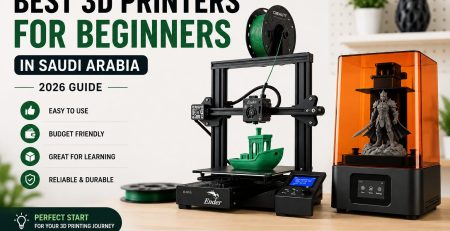
Best 3D Printers for Beginners in Saudi Arabia (2026 Guide)
Starting your 3D printing journey can feel overwhelming, especially with so many printer types, features and price ranges available in...